The break-even rule
A contract bought at a price of p cents wins (100 − p)¢ and loses p¢. Before fees it breaks even when your win rate equals the price. Kalshi's fee, 7% × price × (1 − price) per contract, pushes the bar higher.
| Price | Win | Loss | Fee | Break-even |
|---|---|---|---|---|
| 50¢ | +50¢ | −50¢ | 1.75¢ | 51.8% |
| 70¢ | +30¢ | −70¢ | 1.47¢ | 71.5% |
| 90¢ | +10¢ | −90¢ | 0.63¢ | 90.6% |
| 97¢ | +3¢ | −97¢ | 0.20¢ | 97.2% |
Fee is per contract, before rounding; Kalshi rounds the fee up, so a single-contract order can cost a little more. Can you lose money on Kalshi? works through a full trade.
Two traders, same win rate
Trader A buys at 90¢ and wins 9 of 10. Nine wins earn 9 × 10¢ = 90¢. One loss costs 90¢. Net: zero before fees, and negative after them.
Trader B buys at 70¢ and wins 9 of 10. Nine wins earn 9 × 30¢ = $2.70. One loss costs 70¢. Net: +$2.00 before fees.
Same 90% win rate, very different results. What separates them is the price each paid relative to how likely the contract really was to win.
Edge is the number that matters
Edge is the difference between the true chance of a contract winning and the price you pay for it, less the fee. If a contract really wins 93% of the time and you pay 90¢, you have about 3¢ of edge per contract before fees and about 2.4¢ after. If it wins 88% of the time, you lose about 2.6¢ per contract after fees, however often you win.
What the data shows
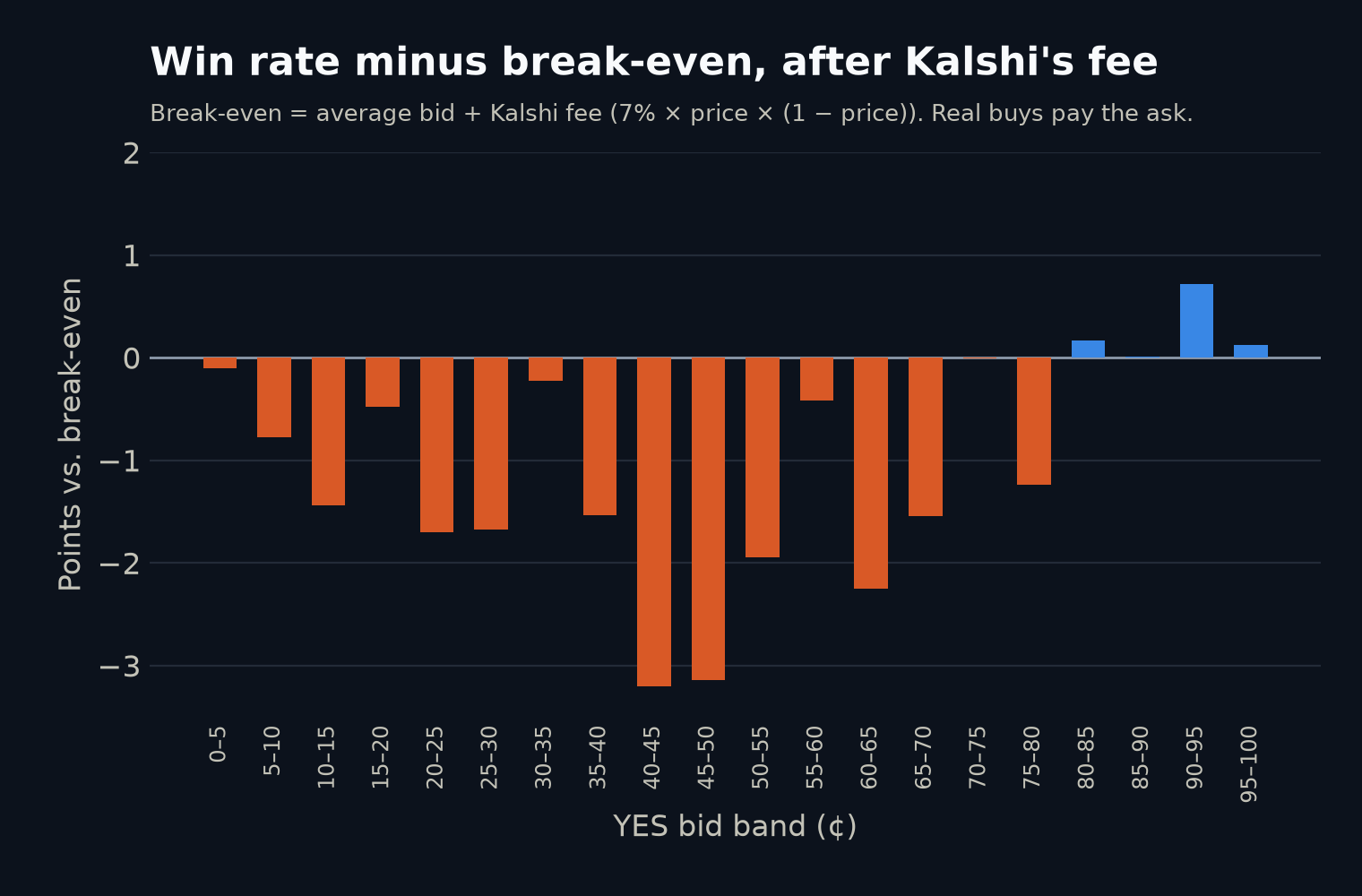
We took the YES bid at eight fixed times before close in 9,312 settled Kalshi BTC 15-minute markets (July 17 – October 23, 2026), grouped the bids into 5¢ bands, and compared how often each band won with its break-even win rate after the fee, using each band's average bid as the price.
- Below 80¢, every band fell short of break-even or landed on it, even at the bid. The biggest shortfalls were in the 40–50¢ bands, about 3 points.
- From 80¢ up, bands came out at or slightly above break-even at the bid, by at most 0.72 points. Bids of 90–95¢ won 93.8% of the time against a break-even of about 93.1% at their 92.6¢ average.
- The 95¢-and-up "sure things" won 99.1% at a 98.9¢ average bid. One loss at 99¢ wipes out about 99 wins at 1¢ each.
Real buys pay the ask, which sits above the bid, and this data doesn't measure the gap. So the small margins at 80¢ and up only survive if the spread is narrower than they are. The prices already track how often each side wins, and no band left more than a sliver of room. The full table is in how often 90¢ contracts win.
How SpectralEdge uses this
SpectralEdge doesn't signal just because it's confident. A signal fires only when its calibrated confidence clears a fixed threshold and the market price leaves a minimum edge. A side the model likes, but that's already priced in, gets no signal. How SpectralEdge decides YES or NO explains the rest.
Common questions
What win rate do I need to break even on Kalshi?
Your average price, plus Kalshi's fee. At 90¢ that is about 90.6%; at 50¢ about 51.8%. If you pay 90¢ and win 90% of the time, you lose the fee on every trade.
Are 95¢ or 99¢ contracts free money?
No. In 9,312 Kalshi BTC 15-minute markets, YES bids of 95¢ and up won 99.1% of the time at a 98.9¢ average bid, which is roughly what the price said. One loss at 99¢ takes back about 99 wins at 1¢.
Does always buying the favorite work on Kalshi?
Not reliably. In our data, contracts bid at 80¢ and up beat break-even after the fee by at most 0.72 points at the bid, and real buys pay the ask, which is higher. Below 80¢, every band fell short of break-even or landed on it.
How do I work out my edge on a trade?
Estimate the real chance the contract wins, then subtract the price you pay and the fee. A 93% chance bought at 90¢ is about 2.4¢ of edge per contract after the fee; a 90% chance bought at 90¢ is negative.
Is win rate useless for judging a strategy?
On its own, yes. Pair it with the average price you paid: a win rate above your average price plus fees means you made money; below it, you lost, however high the win rate.