The question each market asks
A new market opens every 15 minutes, around the clock: 96 a day, weekends included. Kalshi's rules for each one read like this (from a market that ran 11:00 to 11:15 PM EDT on October 23, 2026):
If the simple average of the sixty seconds of CF Benchmarks' BRTI before 11:15 PM EDT on Oct 23, 2026 is at least the simple average of the sixty seconds of CF Benchmarks' BRTI before 11:00 PM EDT on October 23, 2026, then the market resolves to Yes.
So YES means "up or flat over the 15 minutes" and NO means "down". The "target price" shown in Kalshi's app is the opening average, and each market's closing average becomes the next market's target.
What decides the result
- The index, not an exchange. Settlement uses CF Benchmarks' Bitcoin Real-Time Index (BRTI), which aggregates prices from several major exchanges. The price on Coinbase, Google or a chart can differ from it by enough to flip a close market.
- A one-minute average. In the last minute before the close, 60 index prices are collected, one per second, and averaged, rounded to two decimals. The open is measured the same way. A spike in the final seconds moves the average far less than it moves the live price.
- Ties go to YES. The rule says "at least", so a close exactly equal to the open resolves YES.
- $1 per winning contract. A YES contract pays $1.00 if the close average is at least the open average. A NO contract pays $1.00 if it's lower. The losing side pays nothing.
A real example
Two consecutive markets from the evening of October 23, 2026, with each market's opening and closing 60-second averages:
| EDT | Open → close | Result |
|---|---|---|
| 10:30–10:45 | $80,843.45 → $80,832.84 | NO, −$10.61 |
| 10:45–11:00 | $80,832.84 → $80,875.28 | YES, +$42.44 |
A $10 move on an $80,000 asset decided the first market. Across 9,358 settled markets from July 16 to October 23, 2026, half ended within $54 of their open and about 1 in 8 within $10, which is why the exact index and the averaging matter. Note how the second market's open is the first market's close.
What the prices mean
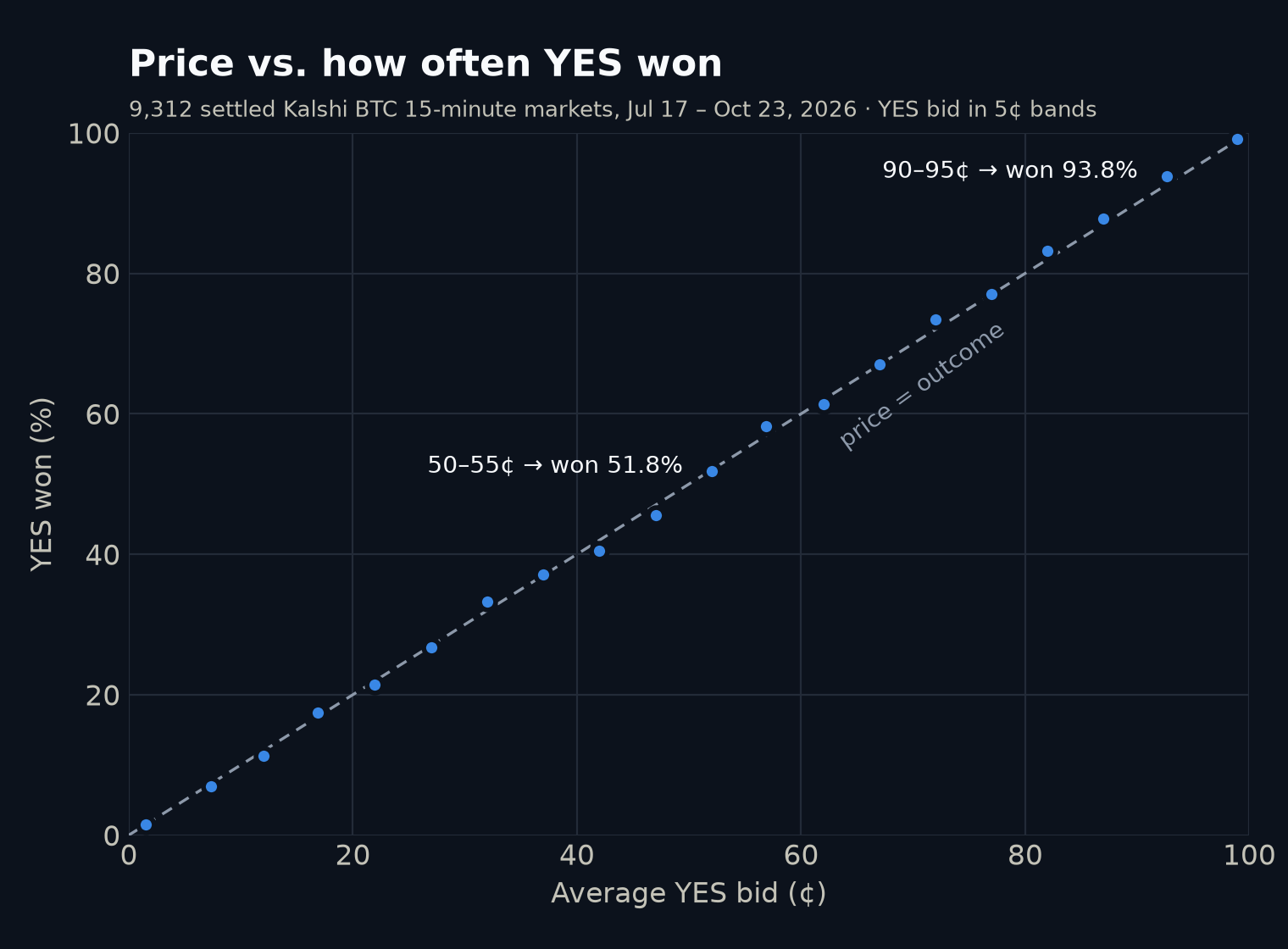
Contracts are priced between 0 and $1. A YES price of 62¢ means the market is paying 62¢ for a $1 payout if bitcoin finishes up or flat: roughly a 62% implied chance, before fees. Buying at that price only makes sense if you think the real chance is higher than 62%. That gap between your estimate and the price is the edge, and it matters more than how often you win.
The prices have been a good estimate. Across the 9,312 settled markets with recorded bids from July 17 to October 23, 2026, the YES bid at fixed times before close won within about 2 points of its price in every 5¢ band: bids of 50–55¢ won 51.8% of the time, and bids of 90–95¢ won 93.8%. The full table is in how often 90¢ contracts win.
Fees
Kalshi's fee for these markets is 7% × number of contracts × price × (1 − price), rounded up. It is largest near 50¢: about 1.75¢ per contract at 50¢, 1.47¢ at 70¢ and 0.63¢ at 90¢. Kalshi rounds the fee to the cent or a fraction of a cent depending on how your account is cleared. The fee raises the win rate you need to break even; why a 90% win rate can still lose money has the full table.
Placing and closing a trade
- Buy at the ask, or rest a limit order. Taking the current ask fills now. A limit order at your own price waits for someone to sell to you, and may not fill before the close.
- YES and NO are two sides of one contract. Buying NO at 38¢ is the same position as selling YES at 62¢.
- You can sell before the close. Selling at the current bid locks in a gain or limits a loss without waiting for settlement.
- Settlement takes minutes. Kalshi's market data lists an expected settlement time 5 minutes after the close; winnings are credited when the market settles.
Things that catch new traders
- Watching the wrong price. The market settles on the BRTI average, so an exchange chart can look "up" while the market resolves NO.
- Treating late prices as free money. Late in a market, the leading side often trades at 90¢ or more. Those contracts usually win, but each loss costs nine or more wins.
- Trading every market. With 96 markets a day, small costs per trade add up fast. Most of the time the price leaves no edge, and skipping is the right call.
Common questions
What happens if bitcoin ends exactly where it started?
The market resolves YES. Kalshi's rule asks whether the closing average is "at least" the opening average, so a tie counts as up.
How many bitcoin 15-minute markets does Kalshi run a day?
96: one every 15 minutes, around the clock, including weekends. Each market's closing average becomes the next market's opening level.
Why did my market settle differently from the chart I was watching?
Kalshi settles on a 60-second average of CF Benchmarks' Bitcoin Real-Time Index, not on Coinbase, Google or any single exchange. Near the open level, a few dollars of difference between the two can flip the result.
Can you sell a contract before the market closes?
Yes. You can sell at the current bid any time before the close, which locks in a gain or limits a loss without waiting for settlement.
When does Kalshi pay out on a 15-minute market?
When the market settles. Kalshi's market data lists an expected settlement time 5 minutes after the close.
Does Kalshi have 15-minute markets for other coins?
Yes. Alongside bitcoin, Kalshi lists 15-minute up/down markets for ether, Solana, XRP and Dogecoin, all settled on CF Benchmarks indices.